
Skip to Content

Tag Archive: Metal Fabrication

  1. Back to Basics: How to Get a Prototype Manufactured

    Comments Off on Back to Basics: How to Get a Prototype Manufactured

    There are recurring customers who have been with us for decades and order bulk-quantity productions. There are also people brand new to the world of sheet metal fabrication who walk through TEDCO’s doors all the time.

    Back to Basics: How to Get a Prototype Manufactured Once in a while, it is best to go back to basics and explain processes that are at the very foundation of what we do, such as how to get a prototype manufactured

    Precision sheet metal prototyping gave TEDCO the foundation to execute the larger projects we do today. When our company was just a father, son, and a small metal shop, prototyping was all we did. 

    Prototyping is the process of quickly building a simplified version of a product to test ideas, gather feedback, and, in some cases, go back to the drawing board for revisions.

    Let’s Talk Steps 

    Preparing Your Digital Model 

    Before requesting an estimate from TEDCO, you have to create a DFM, or Design for Manufacturability. You have to ensure your design uses standard material thicknesses and consistent bend radii, as well as welding, hardware, or finishing call-outs.  Keep in mind to avoid overly complex tolerances or geometries to keep costs low. 

    Manufacturers require a 3D STEP file, DXFs, and possibly other formats, depending on the software used to read the drawing.

    Choose Your Material

    It is best to stick to standard common metal materials like Aluminum, Stainless Steel or Cold-Rolled Steel for the fastest turnaround and lowest costs. If this prototype will not make it to final production and will need alterations before signing off on larger quantities, it’s best to use thinner, less expensive materials. Also smart to choose an in-stock selection from vendors to reduce lead times. Back to Basics: How to Get a Prototype Manufactured

    Submitting Request for Quote

    Now you can email TEDCO directly, or submit on our request for quote form on the TEDCO website to get pricing and lead time before taking the next steps. If there are any further questions for our executive programmer, you can arrange a meeting to discuss the project at hand. Our experts will help you agree on materials, hardware needed, or how to save costs by eliminating certain aspects of the prototype. Coming in for a meeting also presents the opportunity to tour the shop or talk about machining needs.

    This is also the time to decide on finishing treatments such as powder coating, anodizing, or chem film applied for aesthetics or for corrosion resistance. 

    Fabrication Process 

    Once the quote is approved, the purchase order is submitted, and the due date is settled upon, it is time to get this project into fabrication. In the next few months, we will dive deeper into the fabrication steps and the machines used throughout the process. Once completed, the customer typically takes the prototype back to their team or on-site, to see if the part will work as designed. If there are any further revisions that have to be made before the part goes into production, TEDCO is here for the next round of prototyping.
  2. Key 2025 Manufacturing Trends that are Shaping 2026

    Comments Off on Key 2025 Manufacturing Trends that are Shaping 2026

    As the industry moves into the new year, the key manufacturing trends that are shaping 2026 were very much relevant in 2025. As technologies advance and the sheet metal market fluctuates, the fundamentals of sheet metal fabrication remain unchanged. 

    Manufacturers across various industries last year experienced a demand for tighter timelines, evolving requirements, and an increased focus on reliability and quality execution. Manufacturing trends have reinforced the importance of collaboration and adaptability, highlighting the significance of strong partnerships with customers and vendors now more than ever.

    Key manufacturing trends that are shaping 2026

    Interconnected Design and Manufacturing 

    A key trend was close alignment between design and manufacturing. As project complexity increased, the margin of error decreased, leading to the importance of communication between engineering and production. Collaboration became essential to avoid risks and downstream issues. 

    Fabricators who engage with customers thoroughly from the beginning to review tolerances, materials, and manufacturability were best positioned to meet all project goals efficiently within a tighter timeline. 


    Continued Focus on Precision and Consistency 

    One of the most prominent trends of 2025 was the emphasis on quality and repeatability. Especially for a company like TEDCO, where we are used to bulk production and repetitive orders that drive profit most of the year.  Customers increasingly relied on suppliers who consistently held tolerances over hundreds of identical parts. 

    For precision fabricators, this reinforced the importance of robust machine practices, in-progress inspections, and a commitment to doing things right the first time. 


    Efficiency and Project Planning 

    Last year, efficiency and production timeline planning were main priorities. Customers valued fabricators who could balance speed with precision quality while maintaining transparency and predictability. 

    This environment emphasized the importance of clear communication, realistic expectations, and thoughtful planning- especially for complex components with demanding tolerances. 


    Quality as Long-Term Investments 

    Manufacturing trends in 2025 reflected a shift towards quality as a long-term investment rather than a final checkpoint, such as quality control. Strong quality systems, documentation, and traceability continue to play a key role in this upcoming year. It will support customer confidence and regulatory requirements. 

    Quality is now about customer trust, satisfaction, and long-term partnerships.


    The Year Ahead 

    At TEDCO, we are proud of the work we accomplished last year and are grateful for the customers and partnerships we have gained along the way. We look forward to continuing to support precision manufacturing with the same focus and commitment we have had for the last 38 years. Keeping on top of the key 2025 manufacturing trends that are shaping 2026.


    If you are interested in joining our TEDCO family as a valued customer and are ready to see what TEDCO has to offer your projects, email or request a quote today! >

  3. Ebbs and Flows of Precision Sheet Metal

    Comments Off on Ebbs and Flows of Precision Sheet Metal

    Ebbs and Flows of Precision Metal Fabrication 

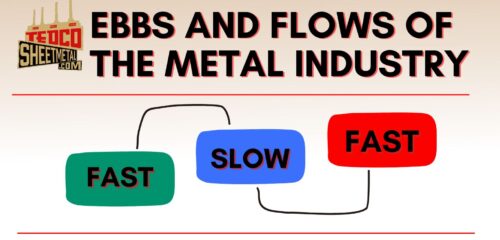
    The sheet metal industry, particularly metal fabrication services, often experience seasonal fluctuations determined by demand. While there is not one universal “slow season” that applies to every metal sector, there are always certain periods of less activity. Let’s discuss key factors that contribute to seasonality and the ebbs and flows of metal fabrication. 

    The needs of other sectors, such as construction, HVAC, agriculture, and electronics, largely drive the sheet metal industry. These industries are significantly impacted by weather conditions that cause delays or even halt outdoor work for seasons at a time. This decreases demand for sheet metal components such as farming equipment or air conditioner enclosures. 

    Ebbs and Flows of Precision Sheet Metal

    Ebbs and Flows of Precision Sheet Metal

    Agriculture is an industry that Tedco works with closely. We manufacture bulk quantities of farming machinery and various component revisions. When certain equipment is needed as crops are in season, metal fabrication is also in high demand. During winter months, or drought, there is little need for equipment manufacturing. This time is usually used to improve machine designs or test prototypes that would help streamline production and keep ahead of competitors.

    In the summer months, we typically see production slowdowns as the heat is hard to work with, and the same goes for winter temperatures. During these times, employees also take time off for vacations or holidays. End of year also has an impact on industry demands as companies manage their inventory and determine they are done purchasing until the year resets or stock is depleted. 

    Economic cycles and uncertainties are the most obvious causes of dips in the sheet metal industry. Broader economic downturns can lead to reduced consumer spending, business investments, and capital expenditures, affecting overall demand for manufactured goods. Read our last blog about navigating tariffs within the metal industry to learn more about their impact on the ebbs and flows of metal fabrication. 


    Strategies for Managing Ebbs and Flows of Precision Sheet Metal  

    Sheet metal businesses can implement various strategies to navigate slow seasons, such as:

    Diversifying service offerings: Exploring services less affected by seasonal factors, such as indoor renovations or specialized fabrication for non-seasonal industries.

    Targeting niche markets: Identifying and serving industries or customers with less cyclical demand.

    Offering off-season discounts and incentives: Encouraging customers to schedule projects during slower periods.

    Investing in maintenance and training: Utilizing slower times for equipment maintenance, employee training, and skill development.

    Strategic scheduling and resource allocation: Optimizing project timelines to align with favorable weather and labor availability.

    Proactive inventory management: Adjusting production and procurement to match anticipated demand fluctuations. 

    By understanding the factors that contribute to seasonal variations and implementing proactive strategies, sheet metal businesses can mitigate the impact of slow seasons and maintain consistent operations throughout the year. 

    Right now is our slow season, so take advantage of quick quotes and the fastest turnaround times of the year! Contact us today to discuss your next project. >