Comments Off on Industry-Grade Reliability During the Holidays
Industry-Grade Reliability: Why It Matters?
In precision metal work, when dealing with industries such as aerospace, agriculture, and medical, reliability is not an option; it is a necessity. A single unit must perform flawlessly under pressure and in bulk production; all must function identically. Especially during the holidays, we commit to delivering industry-grade reliability every single time.
What does Industry-Grade Reliability Mean During the Holidays?
When parts leave our shop, they are not just built to spec; they are made to withstand pressure consistently. Fabricated by people who work through the holiday season to ensure your products are precise and uniform. For us, Industry-Grade Reliability comes down to a few things:
Precision Without Exception:
We specialize in complex, high-tolerance precision welding and fabrication. Whether we are producing new prototypes, agricultural equipment, or biocompatible medical components, quality is never just an option. Our shop is equipped with advanced CNC bending, smooth laser cutting, and high-accuracy tooling operated by well-trained personnel who work over the holidays to ensure that every dimension is exact, every time.
Confidence that Builds Over Time:
One of the most overlooked aspects of reliability is repeatability. Our customers do not just rely on us for one job, but for every job that follows. We invest in our clients, matching pricing on quotes, ensuring deadlines are met, expert communication and delivery services. All these factors help us deliver consistency and adapt quickly when specifications or timelines change.
Unwavering Service During the Holidays:
Whether it is off-season or holiday rush, our reliability and quality fabrication remain the same. We meet our customers where they are, and move to get their projects finished by end-of-year or before companies begin checking out for the holidays. If that means Tedco stays locked in and works through the festive season.
Reliability is Built, Not Bought
At Tedco, we believe reliability is not a single feature but the combination of everything working together: our staff, the machining, tooling, and project management. It is why our customers return to us decade after decade, why our quality holds up, and why we get called for jobs others can not handle.
Comments Off on Holiday Planning and Looking Ahead to 2026
The holiday season presents numerous operational challenges and surprising opportunities. If you plan correctly, you will also be set up for a successful New Year ahead. A well-mitigated strategy will ensure fewer risks with supply chain holiday delays and enhance customer-vendor relationship satisfaction. Together we can navigate this busy time, setting the stage for growth in 2026.
We have developed an end-of-year checklist to help prepare ourselves for the holiday rush, and we find it to be a useful tool for vendors and customers alike. By focusing attention on key areas such as shipping logistics to employee appreciation, we will streamline operations, manage costs, and meet December 2025 deadlines.
Holiday Shipping Logistics
First and foremost is proactive management of shipping logistics as the holiday season increases obstacles. There is immense strain on global supply chains, especially due to uncertainty regarding tariffs. More demand, potential weather disruptions, and holiday blackout dates must be anticipated and planned for accordingly.
It is crucial to get orders in as soon as possible and plan for extra time tacked onto deadlines to avoid such delays. Confirm with your shipping provider the dates they will be closed over the season, and regularly check their website for weather conflicts.
Contingency planning may include identifying alternative shipping providers and shipping routes, or hiring temporary trucking services to mitigate potential impact.
It is also important to monitor tariffs and trade policies. Global trade dynamics can directly impact company costs and lead times. Stay informed about current tariffs, trade agreements, and geopolitical developments that may affect your supply chain.
Stocking Up on Essential Supplies
A surge in holiday orders can deplete company supplies, leading to potential delays if inventory is not accounted for. Checking on the mailroom and shipping supplies well before the holidays to ensure proper needs are met. It is even more helpful to analyze data from previous busy seasons to calculate how much inventory was used, and to anticipate the season ahead.
Order essential supplies in bulk to receive volume discounts on orders. This allows time to document inventory and organize the shipping department with the new product.
Consider purchasing festive packaging for the holiday season. Small touches can enhance customer experience and differentiate your brand from other competitors during the holiday rush. Explore options such as wrapping paper, gift boxes, and greeting cards.
Show Appreciation for Employees and Customers
The end of the year is the perfect time to acknowledge the contributions made by employees, friendly vendors, and loyal customers. Thoughtful gestures can strengthen relationships, loyalty, and boost morale for the upcoming start of the new year. Even a small token of gratitude can leave a lasting impression. Where the gift is a box of candy, new company t-shirts, or a coffee gift card, it will be greatly appreciated. Especially during the holiday season, when work days can get crazy and people are longing to spend quality time with their families.
Consider adding a personal touch to your gifts. Add the company’s logo, get all the staff together for a holiday gift card photo, or, if you have the capabilities like Tedco does, make a gift with company services to demonstrate business abilities in a fun and free way. It serves as marketing, advertising, and appreciation.
Plan for 2026
While it is important to manage the current holiday season, it is also smart to start looking ahead to the upcoming year. For vendors like us, we will be reassuring our customers of our reliability, competitive pricing, and fast turnarounds. We hope the previous great customer service and precision quality will speak for itself in reminding clients why they chose Tedco.
During the month of December, customers will be evaluating supplier performances on the key metrics mentioned above. Everyone wants to make sure they have chosen the right business partners to ensure growth in the new year.
Comments Off on Material Market Updates During TEDCO’s Anniversary Month!
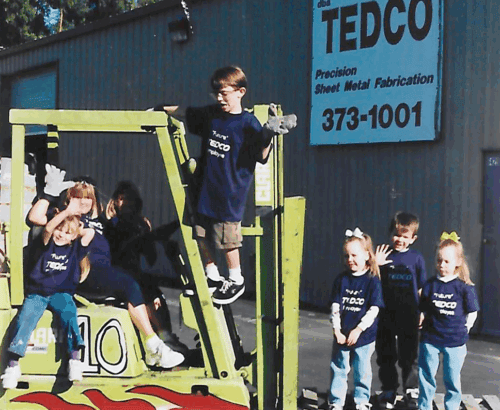
Our company is celebrating 38 years in business this month, and we could not be any more appreciative of those who helped get us here. As we reflect on our growth since 1987, we are proud of our unwavering commitment to precision quality, competitive pricing, and transparent communication between vendors and customers alike. We will also discuss material market updates during TEDCO’s Anniversary month!
Building a family business from the ground up is not an easy task, but through the years, it has remained under family ownership and operation. Despite the loss of our founder, Thomas E. Davis, twenty years ago, his children have kept the legacy alive, thinking of him along the way when things have gotten tough.
Thomas’s son, Michael, is the current owner of Tedco and has written a few short articles in remembrance of this company’s beginnings with his father, and of the lessons learned along the way.
He spoke of small beginnings, with just a press brake in Manteca, a fab shop in Oakland, and machining equipment in his parents’ garage. There, they would quote jobs, outsource most work, and deliver and install the finished products. When outsourcing wasn’t cutting it anymore, they opened a shop just around the corner from Tedco’s current location in 1989.
Under his father’s direction, Michael and his siblings learned for themselves how to manage business finances, CNC program, advanced welding techniques, and how to run various machines necessary to build upon the company year after year.
To learn more about Tedco’s beginnings, visit us on LinkedIn to view published articles or check out our blogs on our website, where we discuss more about our company journey and capabilities.
October 2025 Material Market Updates During TEDCO’s
Now our business has made it to the year 2025, one full on ups and downs in regards to the metal market and imposed tariffs due to the current administration. We think it is important to provide our customers with transparent information, and elaborate on how the current material market trends affect pricing within our industry.
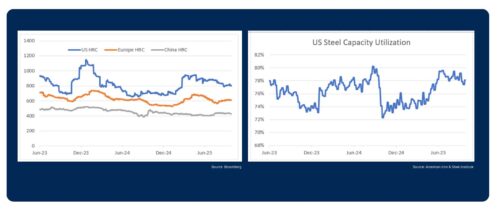
We turn to Ryerson’s monthly market reports for insight to help navigate the ever-changing market and optimize our purchasing strategies. The introduction of new spot indexes and increased tariffs is expected to influence future pricing, but the overall impact remains under observation. The latest updates on various materials include:
Aluminum: Midwest premiums have climbed from around $0.20/lb early this year to around $0.77/lb this October, creating a gap between U.S. delivered costs and global ingot pricing. Buyers who believed imports would offer relief are discouraged to find out that when freight and tariffs are factored in, it does not offer much. With U.S. limited smelting facilities, the market is heavily dependent on Canadian supply. Tariffs are disrupting the flow and putting added pressure on U.S. Midwest premiums, driving delivered costs.
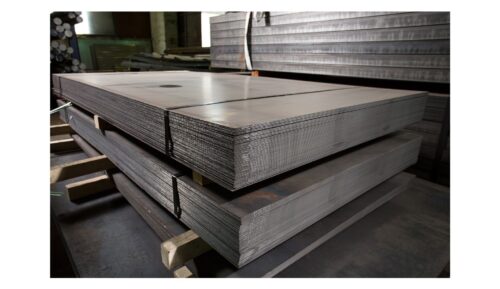
Carbon Steel: Despite broader uncertainties in metal, steel demand remains solid. The demand for steel sheet imports has come down significantly due to tariffs reducing competitiveness for foreign steel. Buyers are increasingly sourcing from U.S. mills despite having to pay premium rates compared to offshore. Steel pricing has appeared stable after recent declines; market watchers believe it is in the process of bottoming out. Finally, carbon steel plate has seen an increase of $60/t.
Stainless: Stainless imports have remained surprisingly resilient, even after tariffs, particularly from regions where foreign suppliers can still compete on cost. Domestic mills like North American Stainless have raised prices modestly, but not enough to close the import gap entirely. Short term, stability could persist for stainless. However, in the longer term, tightening supply and potential mine closures could nudge stainless surcharges higher into 2026.
Red Metals: Nickel is holding steady near $7 per pound, and surcharges have stayed largely unchanged in 2025, which could be a welcome sign for buyers managing long-term projects and fixed-price contracts. But beneath that stability lies a structural challenge. At current prices, as much as 40–50% of global nickel miners are unprofitable, forcing some to consider scaling back operations.
To Sum It Up
A mix of policy spells and price plateaus defines this month’s landscape, where tariffs have once again taken the stage. The latest duty increase on steel and aluminum has conjured fresh volatility—most notably in aluminum.
Despite headwinds from soft demand and shifting policy, the U.S. steel market continues to hold its ground. After a steady slide, prices are stabilizing as trade decisions begin to reshape the flow of steel across global borders.
Many manufacturers remain on the sidelines, still deciding how to balance reshoring, supplier diversification, and cost pressures.
Despite this slow stretch, some end markets are holding firm. Aerospace, industrial machinery, and transportation equipment are performing relatively well, and buyers in those sectors are finding supply conditions stable, if not yet improving.
Comments Off on Precision Metal Medical Equipment: Fabrication and Techniques
Introduction
Our company plays a crucial part in fabricating precision metal medical equipment. Some parts have life-saving objectives, such as stents, self-retaining retractors, implant devices, and many more, with lesser applications. These components must be consistent in size and material, and must be dependable, making the quality of manufacturing critical.
With precision in our name, Tedco Precision Sheet Metal has key methods and techniques to produce reliable and accurate medical components. Processes that include precision prototyping and fabrication, CNC machining or outsourcing to our highly trustworthy machinists, precise welding, and the use of our Amada ENSIS Fiber Laser. Let’s further examine these key fabrication techniques and how they benefit medical component production.
Metal Fabrication Techniques Used for Medical Equipment Parts
To ensure compliance with industry standards, it is important to utilize proper fabrication techniques that emphasize precision.
Sheet Metal Fabrication: Smooth, sterilizable surfaces are crucial to medical procedures. Metal Fabrication Services are vital in transforming raw metal to precise components. It starts with choosing appropriate material weight and thickness and ends with the right finishings, whether that be mirror finish or anodizing.
Laser Cutting: Using our Amada ENSIS 3015 AJe Series Fiber Laser ensures precise and efficient cuts of the intricate designs of medical components. Cleaner edges to parts, with quicker turnaround times.
Welding and Joining Methods: Having a knowledgeable welding department ensures strong, seamless joints for structural durability and integrity.
CNC Machining: Machining is ideal for achieving intricate components with tight tolerances. These techniques produce surgical tools and devices with expert accuracy, enhancing functionality. If we are unable to use our equipment, our trustworthy machinists with similar expertise and decades of experience working alongside our fabrication shop will finish the job!
Why Precision is Necessary in Metal Medical Equipment Fabrication?
Producing precision metal medical equipment that adhere to exact standards within the industry is what medical companies are looking for. They want to make sure metal fabricators have what it takes to withstand the demands of the healthcare environment. Precision and performance are key factors. These parts will be used in high-stakes applications, and manufacturers must adhere to sterilization compatibilities, biocompatibilities, as well as produce tight tolerances to guarantee accurate usage.
Consistency is also crucial to medical equipment fabrication. Our metal shop is well-suited for high-volume production without sacrificing quality. The capability to adapt to specific volume needs is an attribute of our shop, made easier with the addition of our fiber laser.
Shorter Lead Times are great for products that are needed quickly for medical applications and procedures. Once quality is consistent and product errors are reduced, advanced fabrication techniques streamline processes to provide the fastest timelines available.
TEDCO’s Experience in Medical Equipment Fabrication
When it comes to medical components, Tedco Precision Sheet Metal has the expertise to stand out. Customer’s trust us for advance fabrication because we have in business for almost 40 years. Our tooling and techniques are well-equipped to serve the medical industry, providing the accuracy, consistency, and tolerances required for medical part fabrication.
Medical Equipment
For instance, one of the medical equipment parts we produce in bulk quantities is an ultrasonic cleaning baskets. This component removes debris, oils and aid in the lifespan of other smaller metal equipment used in medical procedures and operations. We have made thousands of baskets in various sizes, and they are still available for purchase on our customer’s site.
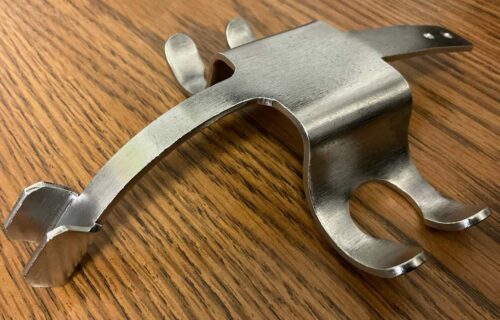
We have also manufactured Self-Retaining Surgical Retractors used to hold tissue open by itself without the need for assistance during procedures. These components are stainless steel and have a finishing coating of passivation or anodization. This part was photographed before the finishing process. Sometimes, medical equipment representatives come to us for prototyping medical components to see if they will make operations run more efficiently, but not all make it to market.
To the left is another medical instrument we manufacture that has a similar application to the surgical retractor. It is just one component of a larger instrument, not fully assembled.
The final piece we will include today is used to hold or rest various other instruments used in procedures. It is lightweight, made from .125 Aluminum and finished in red anodize per the customer’s specifications. We make this in various sizes with more or fewer notches depending on its use.
We offer quality assurance and expert support to optimize designs through requested meetings with our executives. Additionally, Tedco is here to support your project needs and produce reliable medical equipment that meets customer standards. The importance of a fabricator that values precision, scalability, and compliance in medical equipment manufacturing is paramount.
Comments Off on Ebbs and Flows of Precision Sheet Metal
Ebbs and Flows of Precision Metal Fabrication
The sheet metal industry, particularly metal fabrication services, often experience seasonal fluctuations determined by demand. While there is not one universal “slow season” that applies to every metal sector, there are always certain periods of less activity. Let’s discuss key factors that contribute to seasonality and the ebbs and flows of metal fabrication.
The needs of other sectors, such as construction, HVAC, agriculture, and electronics, largely drive the sheet metal industry. These industries are significantly impacted by weather conditions that cause delays or even halt outdoor work for seasons at a time. This decreases demand for sheet metal components such as farming equipment or air conditioner enclosures.
Ebbs and Flows of Precision Sheet Metal
Agriculture is an industry that Tedco works with closely. We manufacture bulk quantities of farming machinery and various component revisions. When certain equipment is needed as crops are in season, metal fabrication is also in high demand. During winter months, or drought, there is little need for equipment manufacturing. This time is usually used to improve machine designs or test prototypes that would help streamline production and keep ahead of competitors.
In the summer months, we typically see production slowdowns as the heat is hard to work with, and the same goes for winter temperatures. During these times, employees also take time off for vacations or holidays. End of year also has an impact on industry demands as companies manage their inventory and determine they are done purchasing until the year resets or stock is depleted.
Economic cycles and uncertainties are the most obvious causes of dips in the sheet metal industry. Broader economic downturns can lead to reduced consumer spending, business investments, and capital expenditures, affecting overall demand for manufactured goods. Read our last blog about navigating tariffs within the metal industry to learn more about their impact on the ebbs and flows of metal fabrication.
Strategies for Managing Ebbs and Flows of Precision Sheet Metal
Sheet metal businesses can implement various strategies to navigate slow seasons, such as:
Diversifying service offerings: Exploring services less affected by seasonal factors, such as indoor renovations or specialized fabrication for non-seasonal industries.
Targeting niche markets: Identifying and serving industries or customers with less cyclical demand.
Offering off-season discounts and incentives: Encouraging customers to schedule projects during slower periods.
Investing in maintenance and training: Utilizing slower times for equipment maintenance, employee training, and skill development.
Strategic scheduling and resource allocation: Optimizing project timelines to align with favorable weather and labor availability.
Proactive inventory management: Adjusting production and procurement to match anticipated demand fluctuations.
By understanding the factors that contribute to seasonal variations and implementing proactive strategies, sheet metal businesses can mitigate the impact of slow seasons and maintain consistent operations throughout the year.
Rapid Prototyping With Tedco Precision Sheet Metal
The clients working with Tedcoare successful through competitive project developments that reduce the time necessary to get products to market. Fast-moving industries like medical, electronics, and agriculture have new designs that often need testing to stay ahead of competitors. Rapid prototyping is used to get engineered concepts to production fast.
Tedco Precision Sheet Metal has highlighted our rapid prototyping capabilities since the beginning. Our experts have decade-long relationships with engineers and manufacturers who have trusted us to produce their designs and identify potential issues before bulk production.
What are the Advantages of Rapid Prototyping?
In the context of precision metal fabrication, the advantage is that rapid prototyping helps engineers refine concepts and test designs before committing to production runs and larger costs. Some want to test prototypes fabricated using money-saving techniques or multiple material variants. The part requirements may take a few iterations of prototyping before being approved. Prototyping helps manufacturers reduce development risks and offers tight tolerances and production-grade quality.
Tedco has optimized the prototyping process by combining precision machinery and expert programming to quickly bring high-performance products to market. We provide the opportunity to validate design concepts and functionality early in the development process, identifying flaws and areas for improvement before they hit the shop floor, saving on cost and time.
Rapid prototyping also allows for customization and personalization to address niche applications and performance. It is an advantage to take a single prototype into the environment where the finished product will live. This ensures all customer standards are met, and all part components are approved by the quality control department before proceeding.
One of the greatest advantages of rapid prototyping is the freedom it provides to foster innovation and experimentation. Having the ability to mock up a design and have a physical iteration through prototyping allows customers to push designs further. The flexibility allows the engineer to optimize different aspects of the metal components, maybe the structural integrity or functionality.
Rapid Prototyping with Tedco Precision Sheet Metal
Tedco has been a provider of rapid prototyping for over 35 years. Our in-house experts will host meetings with potential clients to discuss designs and offer advice on improvements. We will meet requirements from beginning to end. Tedco’s focus is on high-quality components and rapid turnaround, helping get products to market faster.
Tedco rapid prototyping is the highest standard, accuracy, and material grade available. Finishing services are also provided with options to try out multiple finishes for comparisons. Whether you need one-off solutions, or scalable full productions, Tedco has the expertise and prototyping capabilities to support your next project while keeping you ahead of the competition.
Contact our experts today to inquire about our Rapid Prototyping abilities and in-house project management.
Comments Off on Navigating Tariffs in the Metal Industry
Navigating Tariffs in the Metal Industry
The constant flux of tariff regulations is causing uncertainties within the sheet metal manufacturing industry. These changes can impact businesses through increased costs and supply chain delays.
At Tedco, we are dedicated to giving our customers access to metal supplier monthly trend reports to understand how we are navigating tariffs in the metal industry, while maintaining high-quality parts, quick lead times, and precision consistency throughout this changing landscape.
Why Tariff Alleviation Matters in Sheet Metal Fabrication
Tariff mitigation affects companies heavily relying on international materials, leading to price surges and production slowdowns. While the worst-case tariff scenarios seem to have been avoided, the policies are still unstable, causing ripple effects across the global material market.
North American Stainless has introduced a tariff-like surcharge for May shipments, with potential fees included through July. With continued uncertainties, there are talks that other mills may follow, like Constellium, which has also implemented a tariff-related surcharge. This remains a trend to watch, as well as incentives to reshore manufacturing, which will likely increase.
Tariff Implications on Planning and Purchasing Materials
Despite policy shifts, demand is steady for now. As expected, imported materials are becoming less attractive while companies are looking for domestic producers to help avoid fees. Many remain cautious, buying far more conservatively, stocking only what they need for in-house jobs, and rethinking their sourcing strategies. While depot inventory is thinning, perhaps an indicator of future lead-time increases. Supply chain planning and purchasing strategies remain critical.
Metal Market Landscape as of Now*
May 11, 2025: The administration reduced tariffs to 30% after previously increasing tariffs on international imports to as high as 145%. This means a return to slightly calmer waters.
Aluminum, copper, and nickel had tumbled 15-20% in the previous weeks but have now rebounded by roughly 10-15%.
Aluminum- After plunging in early April to nearly $1.05/lb, prices have rebounded to the $1.10 range. This is due to a surge of pre-tariff Aluminum that flooded the U.S. market late last year, creating a temporary buffer that is still working its way through the system. We will see Midwest premiums creep up slowly in the coming months.
Nickel- Pricing is stabilizing around $7/lb; this range is now acting as the natural floor, especially as Indonesia raises royalties on nickel and tin mining.
Steel- Particularly for hot-rolled coil steel, prices are remaining steady at around $900/ton, showing less volatility than other metals. While carbon steel producers like Cleveland-Cliffs are taking capacity offline to remain efficient, possibly triggering a price floor in the coming months.
Our company’s approach to navigating tariffs in the metal industry is with resilience, transparency to our valued customers, andsmart purchasing strategies to maintain our precision quality products, fair pricing, and efficient lead times. We plan on staying vigilant on market updates to remain ahead of the material trends and keep pricing accurate.
We will be strategic when it comes to inventory planning, buying materials conservatively. And maintaining close relationships with our primary suppliers to ensure a transparent supply chain to reduce price spikes.
Tedco also sources domestically, giving us tighter control over costs, delivery, and turnaround times.
Want to know how Tedco can support your next project?- Contact us to learn more about our approach to risk management, precision fabrication, and how we are navigating tariffs in the metal industry.
Comments Off on Fabrication Welding Assembly Makes Tedco a One-Stop Shop
Our Start as a Fabrication Welding Shop Sets Us Apart
Not all metal manufacturers offer fabrication welding assembly. This is the process of joining metal components together through various welding techniques to produce the final project. We started with just a couple of machines and a welding department, and have only advanced over time in expertise. This provides our customers with a one-stop shop experience that saves time and money while producing precision welding services. Let’s expand on what fabrication welding encompasses and our shop’s welding department capabilities.
What is Metal Fabrication Welding?
Tedco’s first welding department from 1989.
Welding is a crucial part of many metal fabrication projects, described as two or more pieces of material joined together by melting the edges to one another, often by adding filler material to create a stronger and permanent bond. Fabrication Welding relies on intense heat and a steady hand for the most precise application.
Fabrication welding includes a range of techniques, each with their own unique advantages. These include Arc welding, MIG welding, TIG welding, spot welding, and the newest technique on the market, laser welding.
Arc Welding- Materials are fused together using heat generated by an electric arc. This process is cost-effective but takes a skilled operator.
MIG Welding- An electric arc is created between a continuously fed metal wire electrode and the metal workpiece. We use a shielding gas, typically argon, to protect the weld from atmospheric contamination. The advantages are quick and easy to learn, speed, making it suitable for bulk production, and versatility. We typically use weld machines by Lincoln Electric.
TIG Welding- Process using a non-consumable tungsten electrode and inert gas to create a weld. Unlike MIG, the tungsten electrode does not melt and becomes part of the weld. TIG offers precise control for delicate applications.
Spot Welding- A type of resistance welding that uses pressure and a passing electric current to join material at localized spots. This technique is quick and easy with little heat distortion, but small localized spots are more likely to break welds.
The LightWELDXR
Laser Welding- Joins materials together using a focused high-intensity laser beam to melt and fuse them, particularly used for thin materials. This process is highly precise and fast, but the equipment’s starting costs are higher than other welding machines. We use the LaserWELDXR made by IPGPhotonics.
Our shop has the capabilities and equipment for all fabrication welding types and techniques. Tedco is a one-stop shop for metal fabrication and welding assembly. This gives customers the option to choose whichever welding application works best for their metal fabrication needs.
What advantages does our in-house fabrication welding offer in project assembly?
Welding is a critical step in the assembly of metal fabrication projects. During the process, smaller metal components are joined to form a unified structure, creating strong and durable connections between parts, ensuring the integrity and functionality of the final product.
Using our in-house welding department minimizes the need to move parts between vendors, streamlining production to keep costs manageable. This also leads to faster turnaround times and higher responsiveness to changing project needs. Projects are consistent in quality, and more flexibility is obtainable through reliable communication.
In-house welding assembly also facilitates customization, allowing for existing structures to be repaired or modified to meet customer’s needs. Often, we see metal electrical boxes bought wholesale, then we modify them for certain applications or plug-ins, contributing to the adaptability of customized designs.
We are a One-Stop Shop
Tedco Precision Sheet Metal is the only place you’ll need to fabricate your upcoming projects. Along with our metal machining and fabrication capabilities, we offer welding assembly and post-production services, including expert support, quality control, and project management. We also prides itself on value-added services such as our network of outside finishing vendors and our fleet delivery options.
We have been a trustworthy source for sheet metal fabrication needs for various industries and also local companies for over 35 years. Your satisfaction is our top priority, and we especially aim to provide expert communication and to ensure project goals are accomplished.




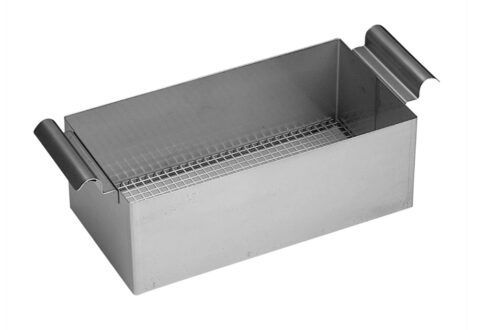 For instance, one of the medical equipment parts we produce in bulk quantities is an ultrasonic cleaning baskets. This component removes debris, oils and aid in the lifespan of other smaller metal equipment used in medical procedures and operations. We have made thousands of baskets in various sizes, and they are still available for purchase on our customer’s site.
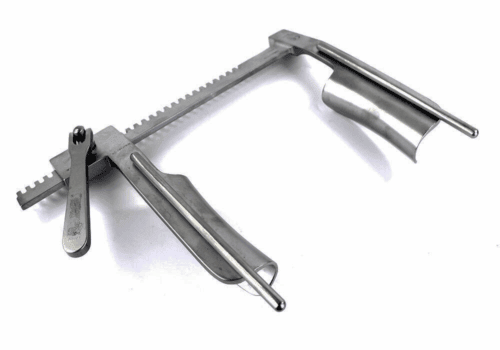 photographed before the finishing process. Sometimes, medical equipment representatives come to us for prototyping medical components to see if they will make operations run more efficiently, but not all make it to market.