Skip to Content

Tag Archive: Metal Fabrication

  1. Surface Finishings on Metal Parts

    Comments Off on Surface Finishings on Metal Parts

    For a majority of metal fabrication jobs, the components are not complete until they receive finishing services. Surface finishings on metal parts play a critical role in how the material performs or how long the part is used. 

    Surface finishings serve multiple purposes, from enhancing the overall appearance and corrosion resistance to meeting industry standards or company requirements. 

    Finishings on metal parts that Tedco does in-house include deburring, a process that removes sharp edges, unwanted protrusions, or small imperfections called “burrs.” This step ensures safety, enhances aesthetics, and allows parts to fit together properly. 

    Tedco’s owner also uses a specialized machine to polish surfaces from semi-polished to mirrored.

    Weld cleaning is also a surface finish that uses a specialized device to remove heat tint, oxidation, discoloration, and heat scale left behind after welding.  

    Common Outside Service Surface Finishings 

    Tedco has built decades-long relationships with local finishing vendors to give us the best pricing on the market for their services, with the best turnaround times. There are quite a few options for surface finishings provided by our vendors.

    Surface Finishings on Metal Parts

    Anodizing

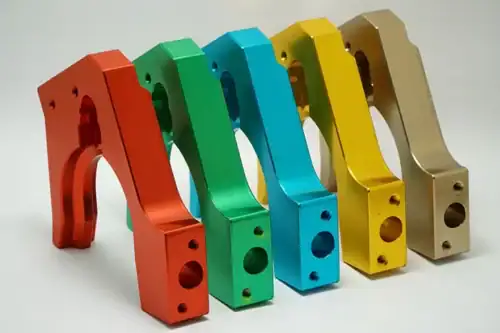
    Anodizing is an electrochemical process that converts the metal surface into a decorative, durable, corrosion-resistant, anodic oxide finish. Aluminum is ideally suited to anodizing, although other nonferrous metals, such as magnesium and titanium, also can be anodized.

    Powder Coating

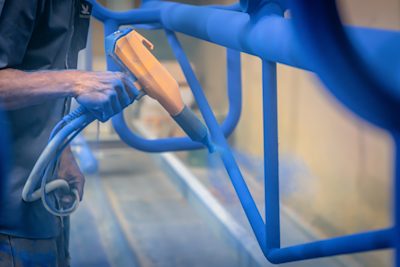
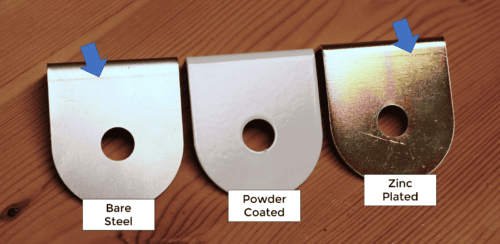
    The powder coating process is a dry finishing technique where a finely ground mixture of resin and pigment is electrostatically sprayed onto a grounded metal part. The part is then baked in an oven, melting the powder into a highly durable, continuous polymer coating that resists chipping and scratches.

    Surface Finishings on Metal Parts

    Zinc and Nickel Plating

    Plating is an electroplating process that deposits an alloy of roughly 12–16% nickel and 84–88% zinc onto a metal part. It serves as a sacrificial, highly corrosion-resistant coating. It replaces traditional zinc and environmentally hazardous cadmium in demanding automotive, aerospace, and defense applications.

    Surface Finishings on Metal Parts

    Passivation

    Passivation is a metal finishing process primarily used on stainless steel to enhance corrosion resistance. It involves a controlled acid treatment that removes surface contaminants and free iron. This allows a protective chromium oxide layer to form naturally. This passive layer protects the metal from rust and environmental damage.

    Bead Blasting

    Bead blasting is a surface finishing process that propels spherical media (like glass beads, ceramic, or metal) at high velocity using compressed air to clean or texture a part. It effectively removes burrs, rust, and surface imperfections while leaving a uniform, matte, or satin finish without altering the part’s dimensions.

    The Right Finish

    Selecting the correct surface finish depends on the type of material used, the performance requirements, aesthetic needs, and the environment. Choosing the wrong process could be a costly decision, and not all are created equal.

    If the components will be exposed to harsh environments- moisture, chemicals, or extreme temperatures the surface finishing must be corrosion resistant. This protects the base and extends the life of the part.  Processes like anodizing, plating, or powder coating are best.

    In high-use or friction applications, the finish must improve resistance to wear and improve longevity. Industries that this would apply to include aerospace, defense, and industrial equipment. 

    If appearances matter just as much as functionality, the finish must reflect quality and attention to detail. Especially if the component is customer-facing, finishing is an important step. 

    How Tedco Supports the Necessary Surface Finishings  

    At Tedco, surface finishes are carefully selected from the beginning of the estimation process. This treats them as a critical step in the fabrication process. Choosing the best fit from the start and working with vendors we have trusted for decades ensures consistency during production. Components are quality-checked to ensure the surface finishes meet functional and visual requirements. 

    In conclusion, surface finishings for metal parts are one of the last steps in production, but their impact is felt throughout the entire lifecycle of the component. The right finish can set your parts ahead of competitors and make sure they are real-world ready.

  2. Why Revisions are Normal in the Prototyping Process

    Comments Off on Why Revisions are Normal in the Prototyping Process

    Introducing a new product into the world may seem like a straightforward process, as described in our blog, “How to Get a Prototype Manufactured,” but there are many obstacles that could arise that lead to early revisions. Developing complex metal components with tight tolerances and unique applications is rarely a perfect design from the start. Refinements are expected; that’s why revisions are normal in the prototyping process.   

    During NPI, or new product introduction, thoughtful revisions in the beginning development stages help identify areas of improved performance, durability, and cost-saving measures. It’s important to pinpoint possible improvements early on to avoid premature production runs that would ultimately produce faulty parts to customer standards.

    Why revisions are normal in the prototyping process

    Why Revisions are Normal in the Prototyping Process 

    Even with a great engineered design, some insights are only visible once in the manufacturing space or in a real-world application. If the need for design modifications is caught before reaching real-time application, costs can be saved in additional production time. Possible causes for revisions could be:

    Component Optimization:

    Improvements that, when made, alter structural integrity, functionality, or overall performance for the better. 

    Manufacturability Improvements:

    Features may seem ideal on paper, but when brought into a manufacturing shop, they could be refined for faster turnaround times or cost-saving measures. Adjustments could be made to the type of welding callouts or requested hardware, all of which would not be recognized until speaking to a manufacturing professional. 

    Material Selection:

    Fabrication may suggest a cheaper metal or material thickness depending on the component’s real-world use. Some material may need testing, or more information to be provided about the type of elements the component will be up against after manufacturing. 

    Installation:

    Sometimes it is necessary to run a first article, or just one part. This ensures fittings are correct and, if assembled with other components, tests how the installation goes. This allows for more revisions to be made before running bulk productions.  

    Why Early Detection is Ideal 

    Early evaluation is crucial in identifying potential challenges or adjustments before production is full-scale. This helps avoid risks of overspending for modifications down the line. 

    Design refinements reduce variations during production, keeping the products consistent and uniform. It also contributes to improving the part’s long-term reliability, identifying which modifications could be made for precision quality and design. Most of the time, this time-consuming step alters the overall design and durability, helping with the transition between prototype to bulk production. 

    Collaboration is Key 

    Successful new product introduction (NPI) is often dependent on the communication between the design engineer and manufacturing programmer. With these two being responsible for ironing out the final touches, they must review the first article and collaborate to make sure the component functions accordingly.

     At Tedco, we work closely with customers during NPI processes to help refine designs, support manufacturability, and ensure that components transition smoothly from beginning to end.

  3. Back to Basics: How to Get a Prototype Manufactured

    Comments Off on Back to Basics: How to Get a Prototype Manufactured

    There are recurring customers who have been with us for decades and order bulk-quantity productions. There are also people brand new to the world of sheet metal fabrication who walk through TEDCO’s doors all the time.

    Back to Basics: How to Get a Prototype Manufactured Once in a while, it is best to go back to basics and explain processes that are at the very foundation of what we do, such as how to get a prototype manufactured

    Precision sheet metal prototyping gave TEDCO the foundation to execute the larger projects we do today. When our company was just a father, son, and a small metal shop, prototyping was all we did. 

    Prototyping is the process of quickly building a simplified version of a product to test ideas, gather feedback, and, in some cases, go back to the drawing board for revisions.

    Let’s Talk Steps 

    Preparing Your Digital Model 

    Before requesting an estimate from TEDCO, you have to create a DFM, or Design for Manufacturability. You have to ensure your design uses standard material thicknesses and consistent bend radii, as well as welding, hardware, or finishing call-outs.  Keep in mind to avoid overly complex tolerances or geometries to keep costs low. 

    Manufacturers require a 3D STEP file, DXFs, and possibly other formats, depending on the software used to read the drawing.

    Choose Your Material

    It is best to stick to standard common metal materials like Aluminum, Stainless Steel or Cold-Rolled Steel for the fastest turnaround and lowest costs. If this prototype will not make it to final production and will need alterations before signing off on larger quantities, it’s best to use thinner, less expensive materials. Also smart to choose an in-stock selection from vendors to reduce lead times. Back to Basics: How to Get a Prototype Manufactured

    Submitting Request for Quote

    Now you can email TEDCO directly, or submit on our request for quote form on the TEDCO website to get pricing and lead time before taking the next steps. If there are any further questions for our executive programmer, you can arrange a meeting to discuss the project at hand. Our experts will help you agree on materials, hardware needed, or how to save costs by eliminating certain aspects of the prototype. Coming in for a meeting also presents the opportunity to tour the shop or talk about machining needs.

    This is also the time to decide on finishing treatments such as powder coating, anodizing, or chem film applied for aesthetics or for corrosion resistance. 

    Fabrication Process 

    Once the quote is approved, the purchase order is submitted, and the due date is settled upon, it is time to get this project into fabrication. In the next few months, we will dive deeper into the fabrication steps and the machines used throughout the process. Once completed, the customer typically takes the prototype back to their team or on-site, to see if the part will work as designed. If there are any further revisions that have to be made before the part goes into production, TEDCO is here for the next round of prototyping.

  4. Key 2025 Manufacturing Trends that are Shaping 2026

    Comments Off on Key 2025 Manufacturing Trends that are Shaping 2026

    As the industry moves into the new year, the key manufacturing trends that are shaping 2026 were very much relevant in 2025. As technologies advance and the sheet metal market fluctuates, the fundamentals of sheet metal fabrication remain unchanged. 

    Manufacturers across various industries last year experienced a demand for tighter timelines, evolving requirements, and an increased focus on reliability and quality execution. Manufacturing trends have reinforced the importance of collaboration and adaptability, highlighting the significance of strong partnerships with customers and vendors now more than ever.

    Key manufacturing trends that are shaping 2026

    Interconnected Design and Manufacturing 

    A key trend was close alignment between design and manufacturing. As project complexity increased, the margin of error decreased, leading to the importance of communication between engineering and production. Collaboration became essential to avoid risks and downstream issues. 

    Fabricators who engage with customers thoroughly from the beginning to review tolerances, materials, and manufacturability were best positioned to meet all project goals efficiently within a tighter timeline. 


    Continued Focus on Precision and Consistency 

    One of the most prominent trends of 2025 was the emphasis on quality and repeatability. Especially for a company like TEDCO, where we are used to bulk production and repetitive orders that drive profit most of the year.  Customers increasingly relied on suppliers who consistently held tolerances over hundreds of identical parts. 

    For precision fabricators, this reinforced the importance of robust machine practices, in-progress inspections, and a commitment to doing things right the first time. 


    Efficiency and Project Planning 

    Last year, efficiency and production timeline planning were main priorities. Customers valued fabricators who could balance speed with precision quality while maintaining transparency and predictability. 

    This environment emphasized the importance of clear communication, realistic expectations, and thoughtful planning- especially for complex components with demanding tolerances. 


    Quality as Long-Term Investments 

    Manufacturing trends in 2025 reflected a shift towards quality as a long-term investment rather than a final checkpoint, such as quality control. Strong quality systems, documentation, and traceability continue to play a key role in this upcoming year. It will support customer confidence and regulatory requirements. 

    Quality is now about customer trust, satisfaction, and long-term partnerships.


    The Year Ahead 

    At TEDCO, we are proud of the work we accomplished last year and are grateful for the customers and partnerships we have gained along the way. We look forward to continuing to support precision manufacturing with the same focus and commitment we have had for the last 38 years. Keeping on top of the key 2025 manufacturing trends that are shaping 2026.


    If you are interested in joining our TEDCO family as a valued customer and are ready to see what TEDCO has to offer your projects, email or request a quote today! >

  5. Ebbs and Flows of Precision Sheet Metal

    Comments Off on Ebbs and Flows of Precision Sheet Metal

    Ebbs and Flows of Precision Metal Fabrication 

    The sheet metal industry, particularly metal fabrication services, often experience seasonal fluctuations determined by demand. While there is not one universal “slow season” that applies to every metal sector, there are always certain periods of less activity. Let’s discuss key factors that contribute to seasonality and the ebbs and flows of metal fabrication. 

    The needs of other sectors, such as construction, HVAC, agriculture, and electronics, largely drive the sheet metal industry. These industries are significantly impacted by weather conditions that cause delays or even halt outdoor work for seasons at a time. This decreases demand for sheet metal components such as farming equipment or air conditioner enclosures. 

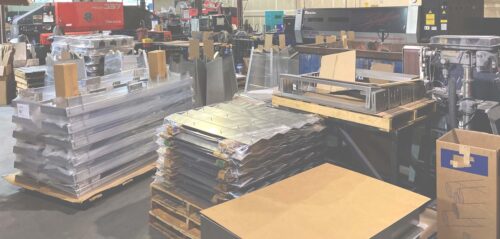
    Ebbs and Flows of Precision Sheet Metal

    Ebbs and Flows of Precision Sheet Metal

    Agriculture is an industry that Tedco works with closely. We manufacture bulk quantities of farming machinery and various component revisions. When certain equipment is needed as crops are in season, metal fabrication is also in high demand. During winter months, or drought, there is little need for equipment manufacturing. This time is usually used to improve machine designs or test prototypes that would help streamline production and keep ahead of competitors.

    In the summer months, we typically see production slowdowns as the heat is hard to work with, and the same goes for winter temperatures. During these times, employees also take time off for vacations or holidays. End of year also has an impact on industry demands as companies manage their inventory and determine they are done purchasing until the year resets or stock is depleted. 

    Economic cycles and uncertainties are the most obvious causes of dips in the sheet metal industry. Broader economic downturns can lead to reduced consumer spending, business investments, and capital expenditures, affecting overall demand for manufactured goods. Read our last blog about navigating tariffs within the metal industry to learn more about their impact on the ebbs and flows of metal fabrication. 


    Strategies for Managing Ebbs and Flows of Precision Sheet Metal  

    Sheet metal businesses can implement various strategies to navigate slow seasons, such as:

    Diversifying service offerings: Exploring services less affected by seasonal factors, such as indoor renovations or specialized fabrication for non-seasonal industries.

    Targeting niche markets: Identifying and serving industries or customers with less cyclical demand.

    Offering off-season discounts and incentives: Encouraging customers to schedule projects during slower periods.

    Investing in maintenance and training: Utilizing slower times for equipment maintenance, employee training, and skill development.

    Strategic scheduling and resource allocation: Optimizing project timelines to align with favorable weather and labor availability.

    Proactive inventory management: Adjusting production and procurement to match anticipated demand fluctuations. 

    By understanding the factors that contribute to seasonal variations and implementing proactive strategies, sheet metal businesses can mitigate the impact of slow seasons and maintain consistent operations throughout the year. 

    Right now is our slow season, so take advantage of quick quotes and the fastest turnaround times of the year! Contact us today to discuss your next project. >