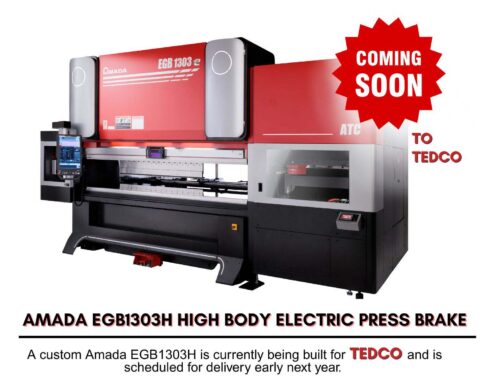
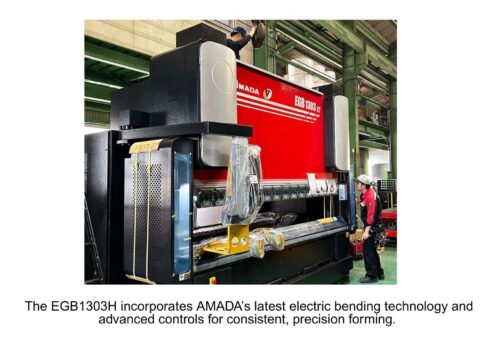
The biggest difference between our new EGB1303H and a standard EGB1303 is the High-Body frame. The additional daylight and open height allow us to bend much deeper parts without interference. This expands our capabilities for tall enclosures, deep channels, complex formed parts, and assemblies that previously required multiple setups or special workarounds.
What This Means for Our Customers
Faster setup times resulting in shorter lead times
More capacity for deep and difficult formed parts
High bending accuracy and repeatability with AMADA all-electric servo technology
Cleaner and quieter operation and less maintenance than hydraulic brakes
Greater efficiency, keeping TEDCO competitive and high-quality
Additional capacity for growing numbers with existing and future customers
A Major Investment for TEDCO’s Future
For nearly 40 years, Tedco has continued to invest in modern manufacturing equipment to provide customers with better quality, tighter tolerances, and dependable delivery. Our new EGB1303H continues that commitment. It will work alongside our existing AMADA equipment to increase throughput, improve consistency, and expand the range of parts we can manufacture in-house.
We’re excited to welcome this machine to our shop early next year and can’t wait to begin producing customer parts on one of AMADA’s newest electric press brakes.
“Every investment we make is focused on one goal—giving our customers better quality, faster turnaround, and the capability to build parts others can’t.”
Comments Off on Ebbs and Flows of Precision Sheet Metal
Ebbs and Flows of Precision Metal Fabrication
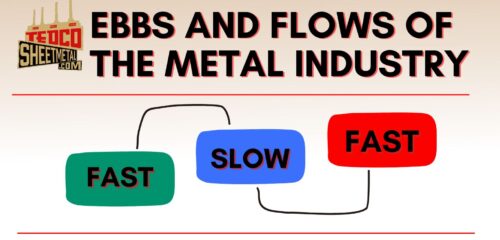
The sheet metal industry, particularly metal fabrication services, often experience seasonal fluctuations determined by demand. While there is not one universal “slow season” that applies to every metal sector, there are always certain periods of less activity. Let’s discuss key factors that contribute to seasonality and the ebbs and flows of metal fabrication.
The needs of other sectors, such as construction, HVAC, agriculture, and electronics, largely drive the sheet metal industry. These industries are significantly impacted by weather conditions that cause delays or even halt outdoor work for seasons at a time. This decreases demand for sheet metal components such as farming equipment or air conditioner enclosures.
Ebbs and Flows of Precision Sheet Metal
Agriculture is an industry that Tedco works with closely. We manufacture bulk quantities of farming machinery and various component revisions. When certain equipment is needed as crops are in season, metal fabrication is also in high demand. During winter months, or drought, there is little need for equipment manufacturing. This time is usually used to improve machine designs or test prototypes that would help streamline production and keep ahead of competitors.
In the summer months, we typically see production slowdowns as the heat is hard to work with, and the same goes for winter temperatures. During these times, employees also take time off for vacations or holidays. End of year also has an impact on industry demands as companies manage their inventory and determine they are done purchasing until the year resets or stock is depleted.
Economic cycles and uncertainties are the most obvious causes of dips in the sheet metal industry. Broader economic downturns can lead to reduced consumer spending, business investments, and capital expenditures, affecting overall demand for manufactured goods. Read our last blog about navigating tariffs within the metal industry to learn more about their impact on the ebbs and flows of metal fabrication.
Strategies for Managing Ebbs and Flows of Precision Sheet Metal
Sheet metal businesses can implement various strategies to navigate slow seasons, such as:
Diversifying service offerings: Exploring services less affected by seasonal factors, such as indoor renovations or specialized fabrication for non-seasonal industries.
Targeting niche markets: Identifying and serving industries or customers with less cyclical demand.
Offering off-season discounts and incentives: Encouraging customers to schedule projects during slower periods.
Investing in maintenance and training: Utilizing slower times for equipment maintenance, employee training, and skill development.
Strategic scheduling and resource allocation: Optimizing project timelines to align with favorable weather and labor availability.
Proactive inventory management: Adjusting production and procurement to match anticipated demand fluctuations.
By understanding the factors that contribute to seasonal variations and implementing proactive strategies, sheet metal businesses can mitigate the impact of slow seasons and maintain consistent operations throughout the year.